
India’s television market was valued at $13.74 billion in 2026 and is projected to reach $37.80 billion by 2034. Smart TV shipments surged 8.6% in 2024, and while 2026 saw broadly flat overall volumes, Q4 alone grew 10% year-on-year as a GST rate cut on screens above 32 inches—dropping from 28% to 18% in September 2025—unlocked a wave of festive demand.
For a regional brand owner, a retail chain, or an importer looking at this market, the question is not whether to be in LED TVs. The question is how to enter without building a factory.
The answer is white-label manufacturing. And if you have been thinking about it but are not sure where to start, this guide covers everything you need to know: screen sizes, operating systems, certification, minimum order quantities, what you can customize, and what to look for in an OEM partner.
What White-Label LED TV Manufacturing Actually Is
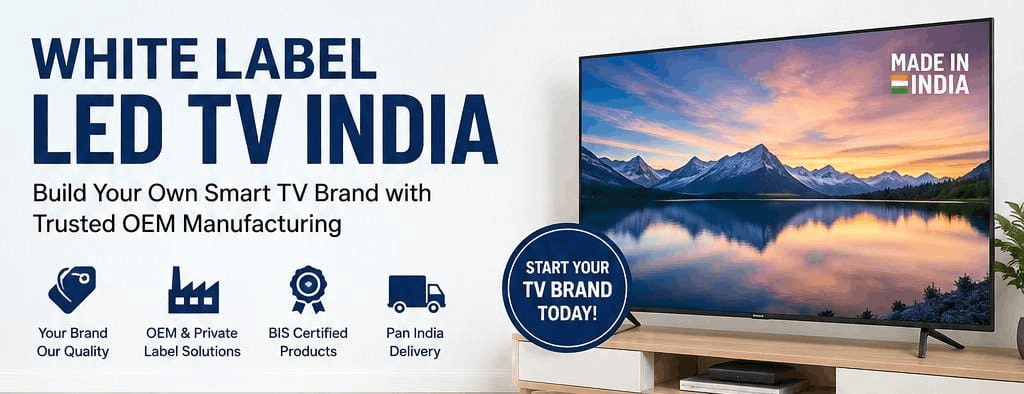
White-label LED TV manufacturing means a brand owner commissions a certified manufacturer to produce televisions that carry the brand owner’s name, logo, and packaging—not the manufacturer’s. The manufacturer handles production, quality control, and certification. The brand owner handles marketing, distribution, and retail.
This is not a new model. Most of the “brands” you see in the ₹8,000–₹25,000 TV segment in India are operating exactly this way. The difference between a strong private-label program and a weak one comes down to who is doing the manufacturing, what certifications they hold, and what level of product customization they offer.
At Haves Technology, we manufacture smart LED TVs from 24-inch to 86-inch under our OEM program. Every unit carries BIS certification. Every product is tested before dispatch. The brand on the box is yours.
The Indian LED TV Market in 2026: What the Numbers Tell You
Before choosing a product range, it helps to understand where demand actually sits.
India’s smart TV shipments remained broadly flat year-on-year in 2025, as a weak first half was offset by stronger GST-led festive demand in the latter part of the year, with Q4 shipments growing 10% on-year.
The size story is particularly important for brand positioning. Larger screen sizes continued to gain share, with 43-inch models recording the highest shipments and models with screen sizes 55-inch and above driving growth. This is a structural shift, not a blip—Indian living rooms are getting bigger, and Indian consumers are spending more on the screen at the center of them.
On technology, QLED shipments nearly doubled year-over-year in 2026, signaling that mid-market buyers are increasingly willing to pay for a visible quality step-up. After the GST Council cut the tax on TVs larger than 32 inches from 28% to 18% in September 2025, brands like Sony, LG, and Panasonic reduced prices by up to ₹85,000, boosting demand for large sets.
For a white-label brand entering now, the sweet spots are clear: 43-inch as the volume anchor, 55-inch and above for a premium tier, and Android TV or Google TV as the operating system for the broadest consumer appeal.
Screen Sizes: Which to Start With
The Haves Technology OEM range spans 24-inch to 86-inch. Here is how to think about which sizes make sense for your brand at launch:
24-inch and 32-inch HD Ready / Full HD entry-level sizes for budget-conscious buyers, second-screen use (bedrooms, kitchens), and rural or semi-urban markets where smaller living spaces predominate. These sit below the 32-inch GST threshold, making them tax-efficient. Our 24-inch HD Ready LED TV is a strong choice for brands targeting the ₹5,000–₹9,000 price band.
The 32-inch smart LED TV is India’s longest-running volume segment. Still the dominant choice in Tier 2 and Tier 3 cities. Now benefits from the post-September 2025 GST reduction, making it more competitively priced than it was 12 months ago. Our 32-inch Smart Android LED TV supports Android TV with Google Play access.
43-inch Full HD and 4K Smart TV The current volume leader nationally. The ₹40,000–₹50,000 price band outperformed the broader market as consumers increasingly opted for better-equipped televisions. Our 43-inch Smart Frameless LED TV is one of our most-requested OEM products. Brands entering at this size position themselves squarely in the market’s highest-velocity segment.
55-inch, 65-inch, and 75-inch 4K Smart TV The premium growth tier. By distribution channel, online portals captured 59.10% of the India smart TV market share in 2025, and it is in this size category that online sales particularly dominate. A brand with a credible 55-inch+ range can establish a premium positioning on Flipkart and Amazon without the fixed cost of branded retail presence.
75-inch and 86-inch For brands targeting commercial installations, hospitality, or a genuine premium consumer tier. Lower volumes, but strong margins and limited competition below the global brand price points.
Operating Systems: Android TV, Google TV, WebOS, or Tizen?
This is one of the most consequential decisions in building a white-label TV range. The OS defines the user experience, the app ecosystem, and the software update trajectory your brand is accountable for.
Android TV is the most widely deployed OS in India’s OEM segment. Backed by Google Play Store, it supports all major streaming apps (Netflix, Amazon Prime, Disney+ Hotstar, and YouTube) and has strong consumer familiarity. Requires a Google license for certified deployment. Haves Technology manufactures Android TV products with full Google certification compliance.
Google TV: The evolution of Android TV, with a redesigned UI that surfaces content recommendations across apps rather than just app icons. Growing in the mid-premium segment. Offers a more polished out-of-box experience. Well-suited for brands positioning above the ₹15,000 entry tier.
WebOS was originally developed by LG and is now available to OEM manufacturers through a licensing program. Offers a premium, clean interface. Good for brands that want to differentiate on user experience rather than compete purely on price. Haves Technology can support WebOS-based builds on request.
Tizen, Samsung’s proprietary OS, is available for OEM use under specific licensing arrangements. Widely recognized by consumers. A strong choice for brands with export ambitions to markets where Samsung’s ecosystem is dominant.
For most brand owners launching in India for the first time, Android TV at the entry and mid-tier, with Google TV for the 43-inch and above range, is the lowest-risk combination—widest app support, best consumer familiarity, and well-understood retail positioning.
What You Can Customise
One of the persistent misconceptions about white-label manufacturing is that you receive a generic product with your sticker on it. With a genuine OEM partner, the customization options are far more extensive.
Visual and brand identity Your brand name and logo on the bezel, stand, remote control, packaging, and boot-up screen. Custom color options on the bezel for brand differentiation. Haves Technology handles all branding elements in-house—you do not need a separate packaging supplier.
Screen specifications, resolution (HD Ready, Full HD, 4K UHD), panel type (standard LED, frameless), refresh rate, and HDR support (HDR10, Dolby Vision) can all be specified per SKU.
Audio configuration, speaker wattage (we offer configurations from 10W to 20W surround), Dolby Audio certification, and speaker placement are customizable within the chassis options available.
Operating system and UI Your brand’s launcher skin can sit on top of Android TV or Google TV, giving users a branded home screen experience. Pre-installed apps, regional language defaults, and featured content placements can be configured.
Connectivity: HDMI ports (quantity and version), USB ports, Bluetooth version, Wi-Fi band (2.4 GHz single-band vs. dual-band), and built-in webcam options for video-calling use cases.
Remote control custom-branded remotes with voice search buttons, OTT shortcut keys (Netflix, Prime Video, and Disney+), and your brand color scheme.
Packaging—custom-printed boxes, user manuals in regional languages, and accessory configurations (wall-mount brackets, HDMI cables)—can be added to your retail pack.
Certification: What You Cannot Skip
Any white-label LED TV sold legally in India must carry BIS certification under the Compulsory Registration Scheme (CRS). This is not the manufacturer’s obligation to manage on your behalf as an informal arrangement—it is a legal requirement for the product entering the Indian market.
When you partner with Haves Technology, the products we manufacture for you are already covered under our BIS CRS registration. The BIS R-number appears on the product and packaging. You are not taking on uncertified inventory and hoping for the best—you are receiving products that have been tested in BIS-recognized laboratories and registered with the Bureau of Indian Standards.
This matters enormously for retail channel access. Skipping compliance can mean rejected shipments, fines, or getting delisted from major platforms like Amazon India or Flipkart. A brand that launches on Flipkart with non-BIS-certified inventory will face listing removal. We have seen this happen to brands that took shortcuts. It does not happen to brands that partner with us.
For export markets — particularly Africa and the Middle East, where several of our partners operate — we can discuss additional certifications relevant to your target country. Requirements vary by market and product.
Minimum Order Quantities and How to Think About Them
MOQ is often the first question brand owners ask, and it is usually the wrong first question. A more useful framing: what volume do you need to commit to in order to establish credible retail presence, and does that volume align with what your distribution network can absorb in the first 60–90 days?
For Haves Technology’s OEM program:
- Entry-level programs are structured for brands testing the market. Lower MOQs per SKU, with the trade-off being less customization depth (standard branding, limited packaging options).
- Mid-tier programs unlock full customization—branded remote, custom boot screen, and packaging—at MOQs that reflect the tooling and setup cost involved.
- Volume programs for established distributors or brands with existing sell-through data offer the most competitive per-unit pricing and the full range of customization options.
We recommend starting a conversation with your sales forecast, not your desired MOQ. Contact our OEM team with your target size range, volume estimate, and distribution channel, and we will structure a program that fits.
Pricing Structure and What Drives It
White-label LED TV pricing from a domestic OEM has several components that brand owners should understand clearly.
Panel cost is the largest single variable. LED panels—particularly for sizes above 43 inches—are primarily sourced from East Asian manufacturers. Panel prices fluctuate with global supply and demand. PLI reimbursements offset volatile panel prices, allowing brands to hold entry prices even as open-cell costs swung 20% since late 2023. Haves Technology manages panel procurement, and our volume relationships allow us to absorb short-term volatility better than a brand owner sourcing independently.
Resolution and OS add cost incrementally. A 43-inch 4K Google TV unit carries a higher build cost than a 43-inch Full HD Android TV unit. The gap narrows at scale.
Customization depth adds setup cost (one-time tooling for custom bezels, for example) that amortizes across your first order and does not recur.
GST is an important structural consideration. The 28% GST slab on televisions beyond 32 inches was reduced to 18% in September 2025. which directly improves the economics of the 43-inch and above segment. For brand owners pricing their retail range, this is a significant tailwind.
What to Look for in an OEM Partner
Not all OEM manufacturers are equal. Here is a practical checklist for evaluating any Indian white-label LED TV manufacturer:
BIS certification—Does the manufacturer hold active CRS registration for the product categories they are quoting? Ask for the R-number. Verify it on the BIS portal.
ISO certification — does the quality management system comply with ISO standards? This governs process, not just product.
Factory visits—is the manufacturer willing to have you walk the production floor before you place an order? A manufacturer with nothing to hide invites inspection.
In-house testing—does the manufacturer test finished units before dispatch, or is QC limited to incoming components? The difference shows up in field return rates.
After-sales support infrastructure — if a unit develops a fault in the field, who handles the warranty claim? A domestic manufacturer with a service network is substantially more valuable than an import arrangement with overseas support.
Track record with brand partners—can the manufacturer point to brands currently selling products they have manufactured? This is the most direct signal of whether the OEM program is real or aspirational.
Haves Technology meets all of the above. We are BIS and ISO certified. We are based in Sector 63, Noida — you can visit us. We test every unit before dispatch. We have service & support infrastructure in place. And we manufacture for brand partners whose products are on shelves in India and in export markets today.
The 2026 Outlook: Why Now Is the Right Time to Enter
Industry analysts expect steady growth in 2026 as the replacement cycle kicks in for pandemic-era purchases and affordability improves for larger screens. This means the cohort of Indian households that bought their first smart TV between 2020 and 2022 is approaching natural upgrade timing — and that cohort is large.
Combined with the post-September 2025 GST reduction making larger screens more affordable, the structural conditions for a well-positioned private-label brand entering in 2026 are genuinely favorable. The brands that establish distribution relationships and retail presence now will be positioned to capture the replacement wave as it builds.
Waiting for perfect market conditions is not a strategy. The market is ready. The manufacturing capability is here. The certification framework exists.
What a brand needs is the right OEM partner.
Explore Haves Technology’s OEM LED TV range.
Haves Technology manufactures smart LED TVs from 24-inch to 86-inch under private-label and OEM programs for brand partners across India and export markets in Africa, the Middle East, and Southeast Asia. All products are BIS and ISO certified. We support Android TV, Google TV, WebOS, and Tizen platforms.
Frequently Asked Questions
Q: What is the minimum order quantity for white-label LED TVs at Haves Technology? MOQ depends on the program tier and level of customization. Contact our OEM team with your size range and volume forecast for a specific quote.
Q: Can I launch my own brand name on Haves Technologies’ products? Yes. Your brand name, logo, and color scheme appear on the bezel, remote control, boot screen, and packaging. We manufacture; you brand and sell.
Q: Are your products BIS certified? Yes. All Haves Technology LED TVs are manufactured under BIS CRS registration and carry the BIS R number on the product and packaging—a legal requirement for sale in India.
Q: Which operating systems do you support? We support Android TV, Google TV, WebOS, and Tizen. Android TV is the most commonly requested for domestic Indian market programs.
Q: Can you manufacture for export markets? Yes. We supply brand partners in Africa, the Middle East, and Southeast Asia. Additional market-specific certifications can be discussed based on your target country.